
Deeds in Caroline County’s Land Record
A deed transfers or confirms an interest in land. Once recorded, it becomes part of the public record. The Clerk of Circuit Court indexes deeds alongside deeds of trust, releases, liens, easements, and plats for Caroline County. Each instrument type signals a different event. The full text spells out the terms, and the legal description identifies the land involved. The index is only a finding aid; review the recorded image or courthouse file itself.
| Deed Type | What It Does | Common Use |
|---|---|---|
| Deed | Conveys or confirms a property interest described in the instrument | Purchase, gift, estate or entity transfer |
| Deed of trust | Records a security interest tied to a loan | Find an encumbrance and later release |
| Release or satisfaction | Shows that a recorded interest was released or satisfied | Check whether a prior instrument has a later filing |
| Fiduciary deed | Transfers land through an executor, administrator or trustee | Estate or trust transaction |
| Plat | Maps lots, lines, easements or a subdivision change | Connect a deed description with mapped land |
A deed and a lien can touch the same parcel for very different reasons. The deed records a transfer. A deed of trust or judgment lien records a claim. Later filings can change an older entry's meaning. A release or satisfaction may cut off what an index line first appears to show. Searches in Caroline County should chase the original instrument. They should also chase anything later that modifies or releases it.
Using Caroline County’s Party Index
Caroline County's land index is built around recorded parties. The grantor gives up an interest. The grantee receives it. To trace a transfer, start with the latest grantee, read that deed, then hunt the named grantor as an earlier grantee. Repeat with the legal description in view. Watch for spelling variants and entity forms in the names, and confirm each match by date, instrument type, and parcel description.
- Search the current owner or recent grantee name and identify the newest matching deed.
- Read the instrument’s grantor, grantee, date, document type and legal description.
- Search the prior grantor as a grantee to find the deed by which that party acquired the land.
- Compare the parcel and lot description at each transfer, then move to an older index or book when needed.
- Grantor
- The party named as giving or conveying the interest.
- Grantee
- The party named as receiving the interest.
- Chain of title
- The sequence of recorded transfers linked to the same land.
- Book and page
- A legacy citation; newer Caroline filings use current index identifiers instead.
Requesting a Caroline County Deed Copy
Begin with the index citation. Decide whether the entry alone answers the question. If not, the deed image is what you need. The Caroline Clerk's remote service gives free access to the index, while images require a registered subscriber account under the county's agreement. The county lists a $50 monthly image subscription. The official records remain at the courthouse. The Clerk can explain how to obtain a copy there, and since no certified-copy or per-page fee schedule is published, request a current quote rather than relying on a third-party mailing.
Recorded, not guaranteed. The index shows documents entered in the record system; it is not a title opinion and cannot rule out an unrecorded claim. A complete title review examines the full chain and related interests.
Caroline County’s 1896 and 1984 Index Eras
Caroline County's land-record access splits into eras. Scanned index books cover December 14, 1896 through March 31, 1984. Computerized indexing began April 1, 1984. It continues to the present. Deed images start with Deed Book 66, dated 1896, and run forward. That split explains a familiar frustration: a free search can return an index reference but no image.
Book and Page indexing ended January 1, 2023 for new land, judgment, and financing-statement records. Search newer instruments by party, date, and the current document identifier. A book/page number will not reach them. For a pre-1896 transfer, move from the county web index to the Library of Virginia's catalog and microfilm resources.
One date field never defines all coverage. Land, liens, wills, and images run separately. When a citation changes format across eras, keep both the old reference and the newer instrument number in your notes. An index date range describes the index, not the survival of every original or the remote availability of each image.
Always test a grantor citation. Check it against the grantee, the recording date, the land description, and any later release or corrective instrument. Mismatches here usually mean the wrong record. Non-subscribers who cannot open an image should ask the Clerk about copy or in-person options. Never treat index text as the complete deed. The Clerk's public remote page describes the Caroline County deed index and image subscription.
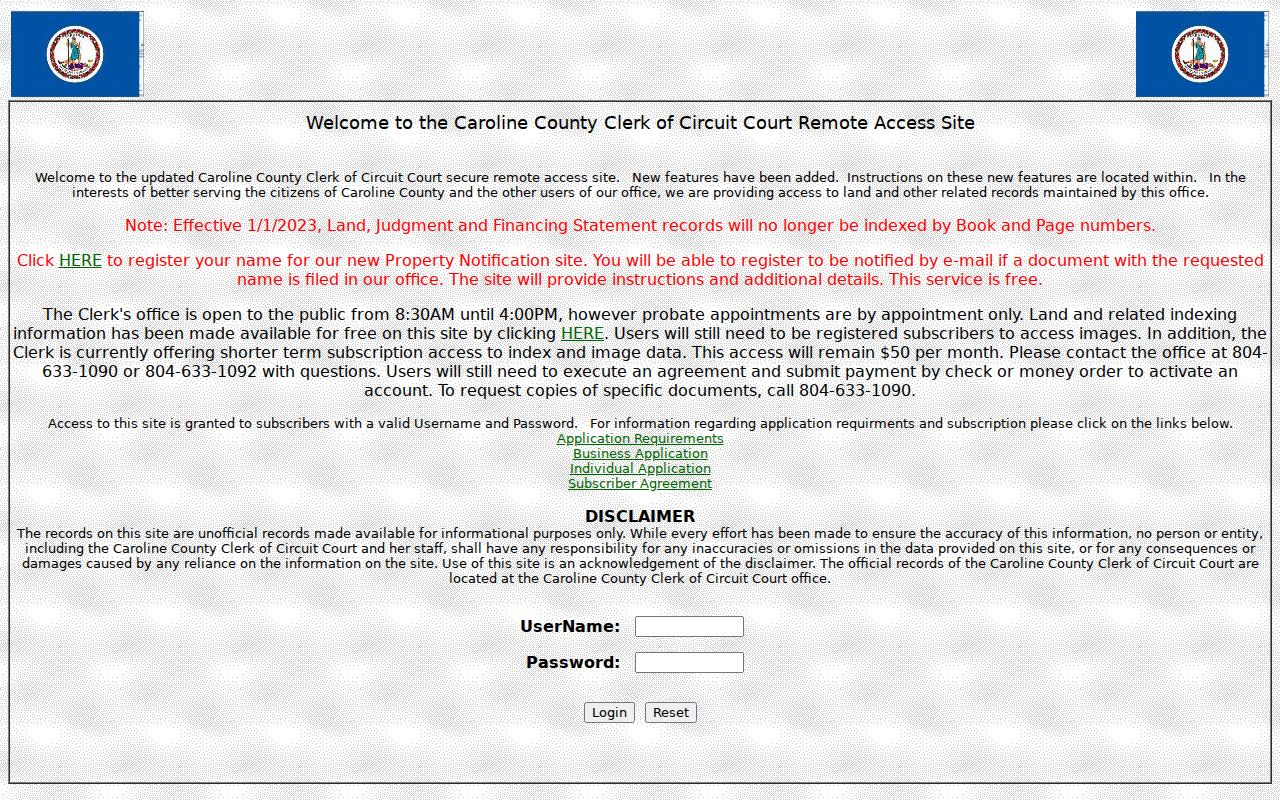
Let the index identify the document first. Then check whether the image needs a subscription or a request to the courthouse.
Search Fields for Caroline County Deeds
The Clerk's materials and the statewide Circuit Court Secure Remote Access guides describe a party-centered search with court selection, instrument filters, date range, and legacy citation fields. The portal publishes no wildcard syntax or dropdown list. Start with a plain party-name search. Narrow by date or document type if the results sprawl.
| Search field | Use | Record-era note |
|---|---|---|
| Court or county | Select Caroline Circuit Court in statewide access | Required in the statewide route |
| Party name | Search an indexed grantor or grantee | Exact wildcard rules were not captured |
| Instrument type | Narrow deeds, releases, liens, easements or plats | Full live option list was not verified |
| Date range | Limit an older or recent search | Useful across scanned and computerized runs |
| Book/page or current document number | Open a known citation | Book/page is not the new-record key after 2023 |
Before trusting a result, note the party roles, recording date, instrument type, and any cross-reference. The index entry is not the deed. The recorded image holds the exact values and formats.
Caroline County Plats and Other Recorded Interests
Plats are part of the recorded record trail. The Clerk's subscriber agreement covers plat images from cabinet 1 forward. A plat can tie a lot number or tax-map section back to a deed citation. It is not a substitute for the map viewer, though. The two tools do different jobs. Lake Caroline drawings in the files show a revised lot and a vacated line. They also carry pointers to deeds and easements. Ladysmith Crossing planning material names five source parcels and eight proposed lots. It lists easements too, plus a flood-map note. Check whether a drawing was finally recorded before relying on it as the operative plan.
The same land-records trail holds other interests. Computerized UCC and financing statements run from 2000 forward. Judgment liens begin in 1993, with scanned judgment indexes covering 1985 through 1992. Deeds of trust, releases, covenants, and easements are searchable by party, date, and legal description. The exact live instrument filter list does not appear online. Ask the Clerk when a category is unclear.
Caroline County Deeds Before the Web Index
Older Caroline County deed records live at the Library of Virginia. Its finding aid covers Caroline Deed Book 1758–1845 on Reel 6, arranged by grantor and grantee with residence and property-description detail. Reel 5 holds a deed index for 1836–1872. Reel 68 adds deed runs from 1815–1859 and 1867–1889. Later catalog entries reach Book 68 and beyond. The county's online image series starts at Book 66, so the state archive is the route for anything earlier.
Caroline is a lost-records locality. Union troops ransacked the courthouse in May 1864. Deed books before 1836 and will books before 1853 were damaged or removed. A near-complete order-book run survived. When a chain of title breaks, try a second source: an order book, probate record, plat, later confirming deed, or land patent. Re-searching the same index rarely fills the gap.
Use the Library of Virginia deed-book finding aid to locate Reel 6, and check the Caroline microfilm list for additional runs.
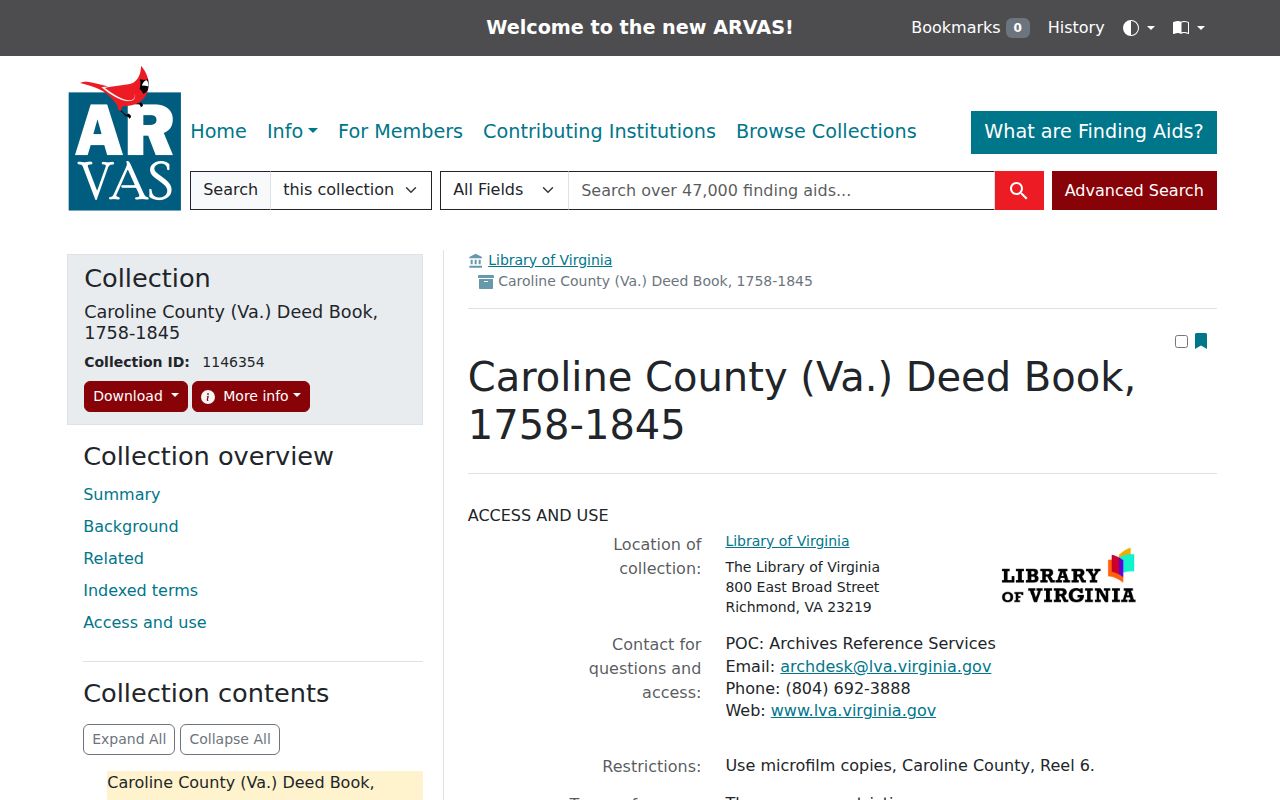
The finding aid supplies collection context and reel detail. The catalog offers the wider inventory of county microfilm.
Caroline County Property Filing Alerts
The Clerk's Property Notification service is a free, name-based alert. Register a name. Email arrives whenever a document with that name is filed. The service does not watch an address or parcel outline. A notice never confirms the filer is the owner of record. Treat each alert as a prompt to pull the filing. It is not a title guarantee or a fraud determination.
The Clerk's office sits at the Caroline County Courthouse, Main Street and Courthouse Lane. Mail goes to P.O. Box 309, Bowling Green, VA 22427. The published phone is 804-633-1090. County pages list slightly different final recording times. Call ahead before a deadline or a courthouse trip. The Clerk's office listing identifies its land-title duties and contact route.
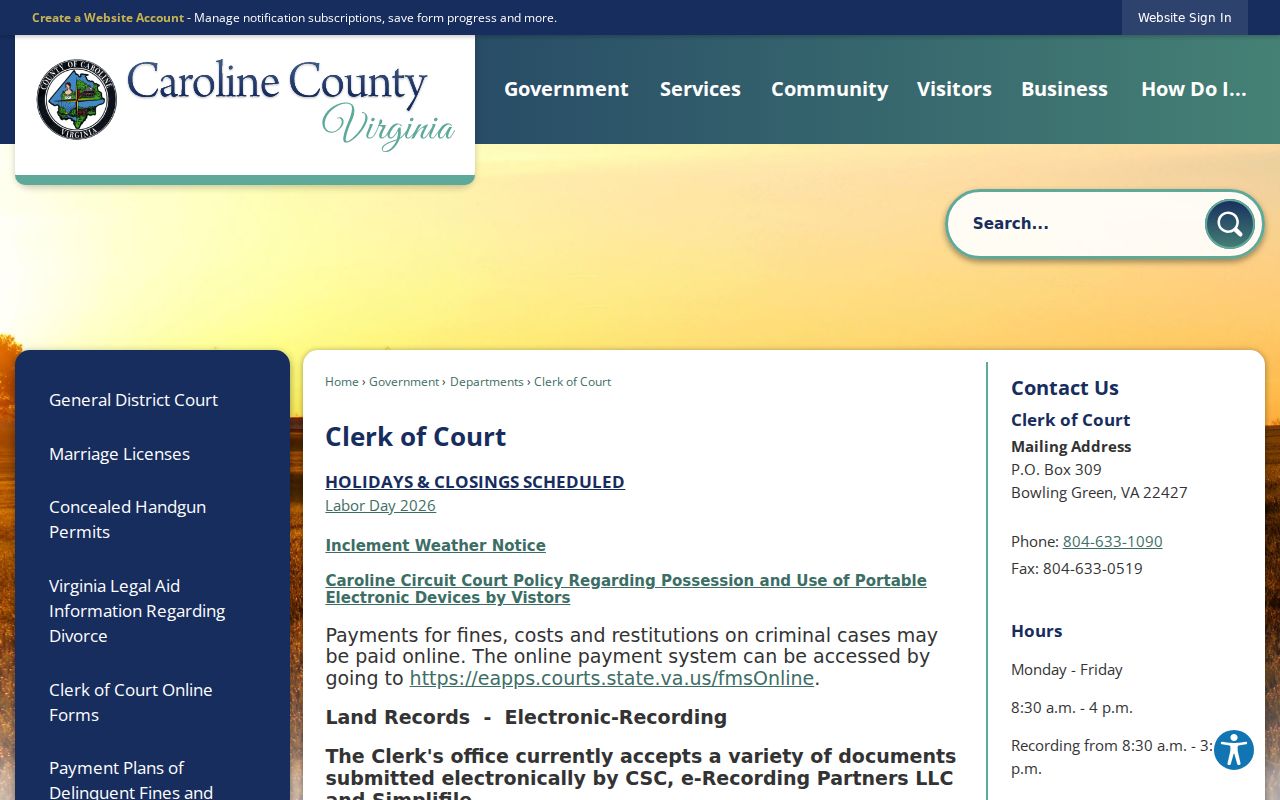
Use the published Clerk contact to confirm copy procedures and to ask about any index entry that will not open remotely.